Global Steel Market Risks: China Inventory, Freight & Tariffs
In the second half of 2026, global steel dynamics face severe headwinds driven by a massive buildup of inventory in Mainland China, escalating maritime freight surcharges across key trading corridors, and aggressive regional trade remedy filings. Commercial buyers across Southeast Asia, particularly procurement managers in Indonesia and Vietnam, are witnessing a structural shift where finished steel prices, shipping rates, and marine insurance must be managed as distinct operational liabilities. As domestic Chinese demand falters under seasonal weather disruptions and a protracted real estate downturn, low steel mill profitability is pushing mill operators to divert record volumes of hot-rolled coil and long products into international export markets, provoking swift regulatory retaliation from neighboring economies.
Inventory Surges and Slumping Mill Profitability in Mainland China
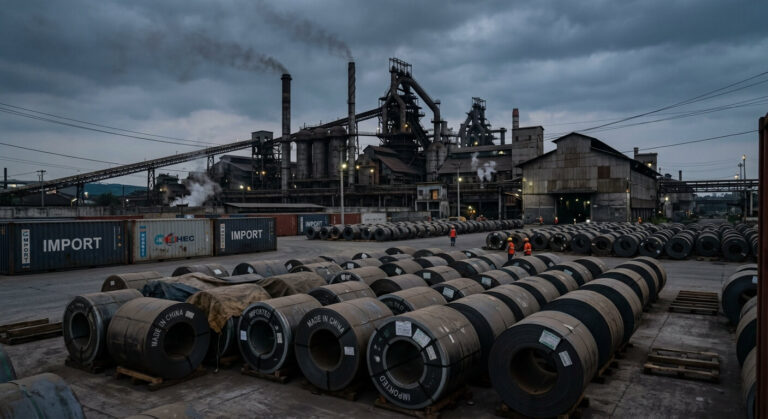
Data from leading market intelligence provider Mysteel reveals that total commercial inventory across the five major carbon steel product categories reached 16.3582 million tonnes, with retail warehouse stockpiles across 132 monitored Chinese cities expanding by 0.6 percent on week to hit 19.19 million tonnes. This accumulation highlights a profound imbalance where recovering mill output intersects with constrained end-user consumption. Long steel products contributed significantly to the weekly build, as rebar inventories climbed 1.2 percent to 7.83 million tonnes, up by 94,800 tonnes, while wire rod stockpiles grew 1.9 percent to 1.82 million tonnes, an increase of 33,500 tonnes. Hot-rolled coil, cold-rolled coil, and medium plate levels similarly reflected sluggish off-take from key manufacturing sectors, including construction machinery and structural steel fabrication, where heavy summer rain and intense heat slowed outdoor job site progress.
Despite four consecutive weeks of production curtailments that pulled China’s daily hot-metal output down to 2.3555 million tonnes, supply discipline has failed to stabilize spot market pricing. Financial pressure on steelmakers has reached critical levels, with a comprehensive industry survey indicating that only 33.77 percent of Chinese steel mills are operating profitably, leaving nearly seven out of ten primary producers absorbing active operating losses. Even as a second consecutive round of coke price cuts reduced raw material input expenditures, the resulting cost relief has served primarily as a lower price floor rather than a catalyst for margin recovery. Market analysts from SMM Steel Analysis
observe that the price spread between hot-rolled coil and rebar on the Shanghai Futures Exchange, which averaged 187 yuan per metric tonne during the first half of 2026 compared to 128 yuan in the same period of 2025, is projected to consolidate within a narrow band of 150 to 250 yuan per metric tonne throughout the second half of the year as manufacturing resilience offsets deep construction weakness.
Maritime Freight Disruptions and Strategic Surcharges in Maritime Routes
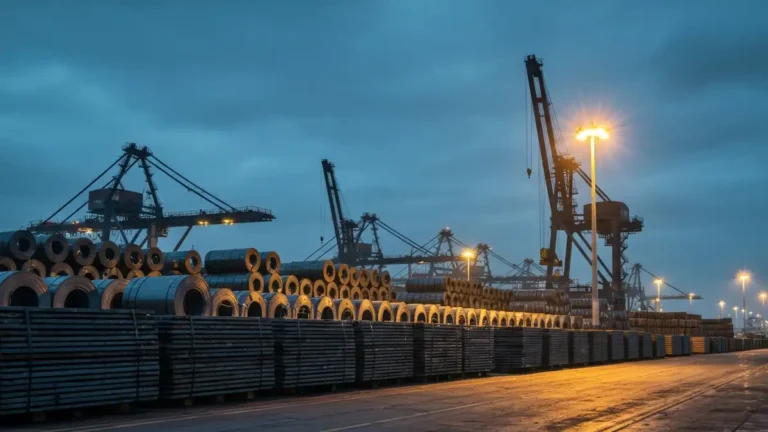
Compounding the pressure of low Chinese export offers is extreme volatility across international ocean freight corridors. Geopolitical friction in the Middle East, marked by tanker security incidents and potential transit bottlenecks near the Strait of Hormuz, has driven Persian Gulf shipping freight rates up by 6.8 percent virtually overnight. Ocean carriers are applying emergency war-risk insurance premiums and bunker adjustment factors, forcing international trade desks to re-evaluate their landed-cost calculations. Industry advisors at Promisteel
emphasized the need for agile procurement strategies, noting that Persian Gulf freight rates have jumped 6.8 percent as Hormuz risks escalate, meaning Indonesian procurement teams must now treat steel prices, insurance, and freight as separate commercial assumptions.
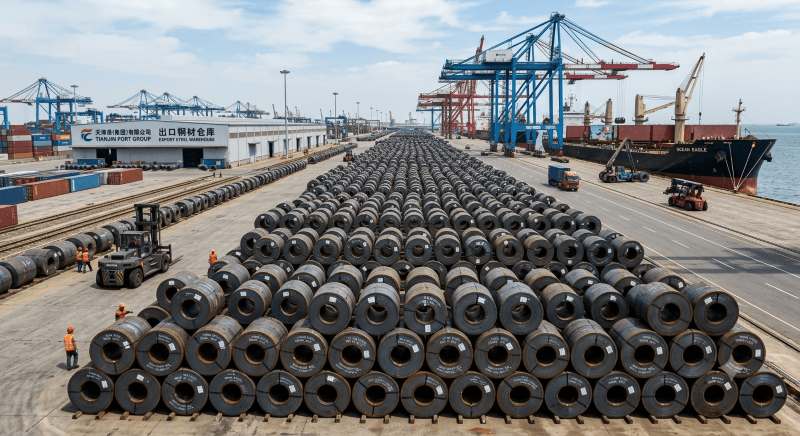
Concurrently, a major schism has emerged in global container shipping lanes, where trans-Pacific routes to North America face dramatic rate spikes while Asia-Europe shipping charges experience rate erosion. Shippers routing material toward the United States have engaged in aggressive front-loading of cargo to get ahead of upcoming trade tariffs and clear supply bottlenecks before peak seasonal volume. Conversely, intra-Asia container lanes are navigating localized port congestion and typhoon-related vessel delays across East Asia. These divergent freight trends mean that while Chinese mill FOB quotes may appear discounted, the total landed price of imported steel coils and prestressing strands in Southeast Asian destinations is subject to erratic ocean shipping add-ons that erode buyer margins.
Downstream Expansion vs. Protectionist Trade Actions in Southeast Asia
Looking toward the broader horizon for flat steel, the South East Asia Iron and Steel Institute highlights a significant structural transition taking place in downstream manufacturing. Approximately 10 million tonnes of brand-new downstream production capacity requiring hot-rolled coil as a primary substrate is scheduled for commissioning during 2026, creating a substantial new absorption channel for flat steel products. Assessing this influx of processing capacity, a Shanghai-based industry analyst told Mysteel Global that new production lines are expected to consume around 10 million tonnes of HRC, which could cushion global prices from a deeper free-fall once these facilities achieve steady-state operations.
However, the immediate threat of aggressive Chinese export volumes has triggered defensive legislative action across neighboring Southeast Asian nations. The Ministry of Industry and Trade in Vietnam has launched a new wave of trade remedy investigations, targeting imported Chinese hot-rolled coil and prestressing steel products with anti-dumping duties. This regulatory crackdown serves as an urgent signal for Indonesian steelmakers and trade regulators, who are assessing similar safeguard measures to prevent domestic market distortion. Adding to regional industry concern, credit rating agency Taiwan Ratings
revised its credit outlook on Taiwan’s largest integrated producer, China Steel Corporation, to Negative while affirming its twAA- and twA-1+ ratings. The agency pointed out that prolonged demand weakness and elevated global trade barriers will keep the company’s EBITDA margins subdued at 10 to 12 percent through 2026, while total debt is projected to stabilize between NT$230 billion and NT$235 billion.
To navigate this volatile trading environment, industrial buyers and procurement directors must move away from traditional fixed-price contracts and adopt dynamic hedging structures. By unbundling base metal prices from freight indices and contingency insurance, supply chain managers can safeguard their capital against unexpected shipping surcharges, volatile HRC-rebar spreads, and sudden regulatory tariff adjustments across Asian steel markets.