The 20% Price Shock: SNI Bottlenecks and the Importer’s Crisis
The implementation deadline for mandatory Indonesian National Standards (SNI) has triggered an unprecedented pre-emptive market shock across the domestic manufacturing sector. Driven by the new framework under Ministry of Industry Regulations Nos. 23 and 24 of 2026 for zinc and aluminum-zinc coated steel products, domestic steel coil prices have spiked by roughly 20% as importers abruptly freeze incoming purchases. This sudden market friction stems from severe administrative bottlenecks, soaring compliance overheads, and a critical lack of testing laboratory capacity ahead of the enforcement date.
The May 20 Deadline: A Market in Anticipatory Shock
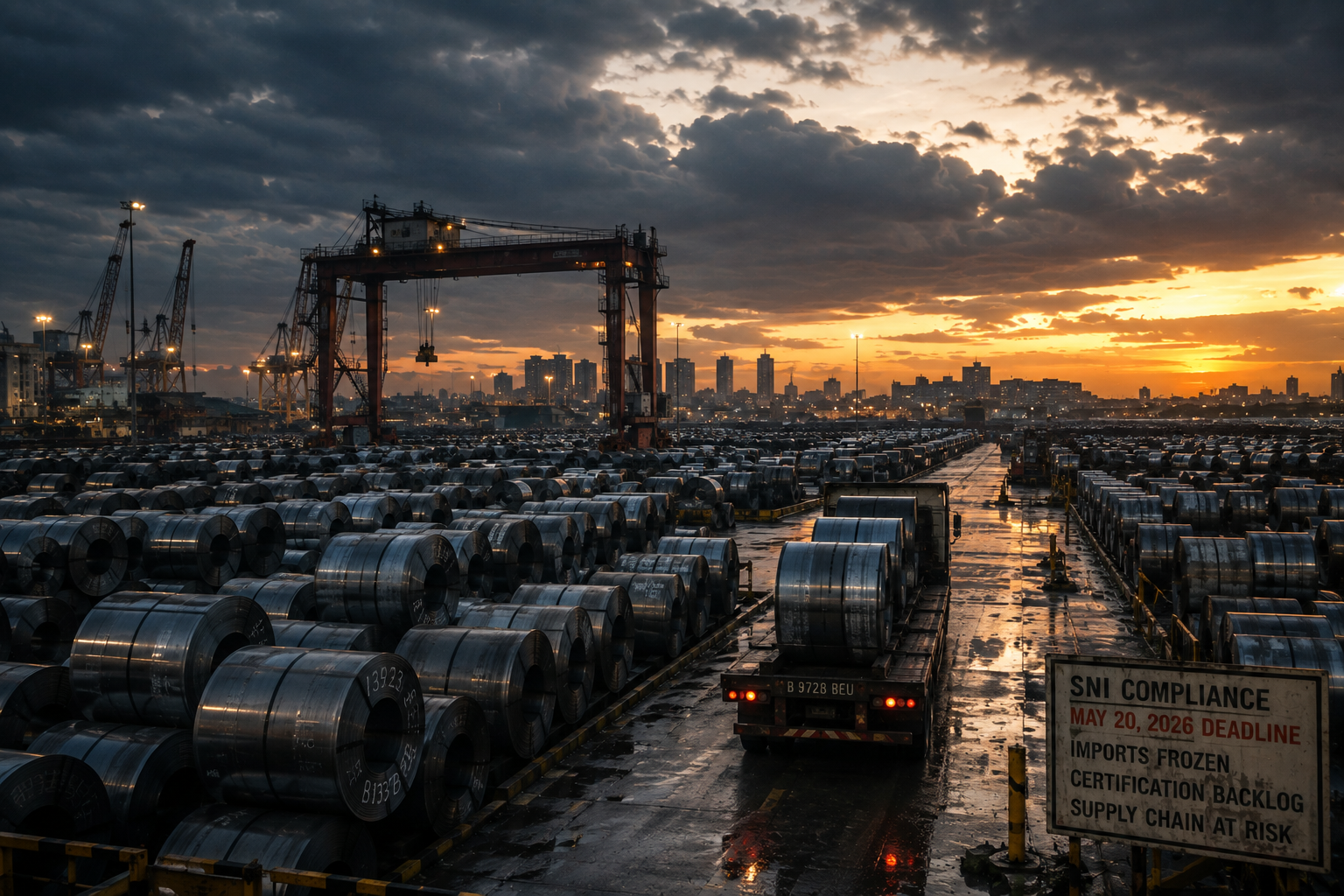
With a hard compliance deadline arriving on May 20, 2026, thousands of brands, traders, and manufacturing companies face an overwhelming rush to certify their product lines. Although a one-year grace period followed the initial regulatory publication in November 2024, national testing infrastructure has completely failed to scale alongside market demand. Consequently, importers have chosen to hold back incoming orders rather than risk heavy penalties or shipment seizures at the ports, creating thin spot-market inventories and throwing downstream supply chains into a state of severe uncertainty.
Infrastructure Failure: The Crisis in Testing Laboratory Capacity
The core of the current gridlock lies in the physical and logistical limitations of national testing facilities. With an immense volume of applications hitting certification bodies simultaneously, authorized testing laboratories are experiencing insurmountable backlogs. Industry associations note that the lack of preparation and testing bandwidth among these facilities threatens to stall raw material processing entirely, risking severe production shortages for light manufacturing, automotive suppliers, and downstream construction projects across the archipelago.
The Financial Burden: Analyzing the Cost of SNI Compliance
Beyond logistical delays, the financial hurdle of certification is proving punishing for small and medium-sized market participants. Securing compliance reportedly costs tens of thousands of dollars per certificate when factoring in sample testing, administrative fees, and factory audits. According to industry groups, these heavy overhead costs threaten to squeeze out smaller independent traders while concentrating market power among legacy giants, raising urgent concerns about market fairness and operational transparency.
“The regulation risks triggering production stoppages, layoffs and opportunities for corruption,” warned representatives from GINSI (National Importers Association).
Supply Chain Risk: Will Thin Stocks Lead to a Construction Standstill?
As importers continue to hold off on purchases to avoid non-compliance risks, domestic inventories are depleting rapidly. Persibri noted that the consequent 20% price spike is already rippling aggressively through downstream pricing structures, increasing project costs for developers and fabricators alike. Without an urgent administrative intervention, a streamlined testing backlog clearance, or a rationalized adaptation window, the domestic market risks moving from a regulatory transition directly into a full-scale supply chain paralysis.
“Importers had already begun holding back purchases in anticipation of the new rules, causing domestic steel coil prices to spike by roughly 20 percent,” reported Persibri.